Gustave Moreau’s students
A Symbolist Among the Future Fauves
This is the paradox I prefer to recount on the third floor, in front of Jupiter and Semele. The most reclusive painter of his century, devoted to myths and gemstones, trained the young artists who, seven years after his death, would shock the Salon d’Automne with pure, flat colours. Fauvism was born, it is said, in Gustave Moreau’s studio. That is not entirely false.
1892: The Beaux-Arts Studio
Moreau was sixty-six when he accepted, in 1892, a position as studio head at the École des Beaux-Arts in Paris. He had never taught before. He continued until his death in April 1898, six years during which 125 students passed through his studio. His method was surprising: he did not ask them to paint like him. He had them copy the masters, as he had done himself, and he asked each to find their own colour. Such freedom was rare in a school that primarily trained Salon painters.
The contrast with his own home is striking. At the same time, he commissioned architect Albert Lafon to transform the townhouse on rue de La Rochefoucauld into a museum, where he hung canvases in which every gemstone was painted with a magnifying glass. The teacher and the painter were not at odds: he taught method, not style. His full biography is on the page Who Was Gustave Moreau?.
Names to Remember
Henri Matisse. The most famous. After a difficult start, he joined the studio and found a master who let him explore. The Fauvist Matisse of 1905 owes to Moreau not so much a technique as a permission.
Georges Rouault. The favourite student, and the closest. He did not become a Fauve: his dark, outlined painting diverged from it. But he was chosen, at the museum’s opening on 14 January 1903, as its first curator. He remained so until 1922, overseeing his master’s studios for nearly twenty years. George Desvallières, another student, took over in 1930.
Albert Marquet, Henri Manguin, Charles Camoin. The three other Fauves from the studio. Marquet, Matisse’s friend since their Beaux-Arts days, would become the painter of quays and harbours. Manguin and Camoin exhibited with them in 1905, when the critics coined the term “Fauves.”
On the second floor, look for Moreau’s freest sketches, those where colour is applied in patches without drawing. They date from his final years, and one instantly understands what Matisse and Marquet may have seen in him.
Was Fauvism born on rue Bonaparte?
I generally answer: partly. Fauvism also owes something to the preceding generation, and to what those painters did after their master’s death. But Moreau’s studio brought together, between 1892 and 1898, a core group of young painters who knew and worked with one another, and it gave them a teacher who did not break their spirit. Without this studio, it is hard to see where Matisse, Marquet, Manguin, and Camoin would have met.
What the museum shows of the teaching
Nothing direct: the students’ canvases are not here; they are in other museums, such as the Musée d’Orsay or elsewhere. But the house demonstrates the method. The copies after the Italian masters on the ground floor are those Moreau had his students make; the drawing cabinets show how he worked a motif through dozens of variations. The itinerary is described on the page works to see, and the history of the bequest and the opening on that of the house-museum.
Seeing the students at Orsay
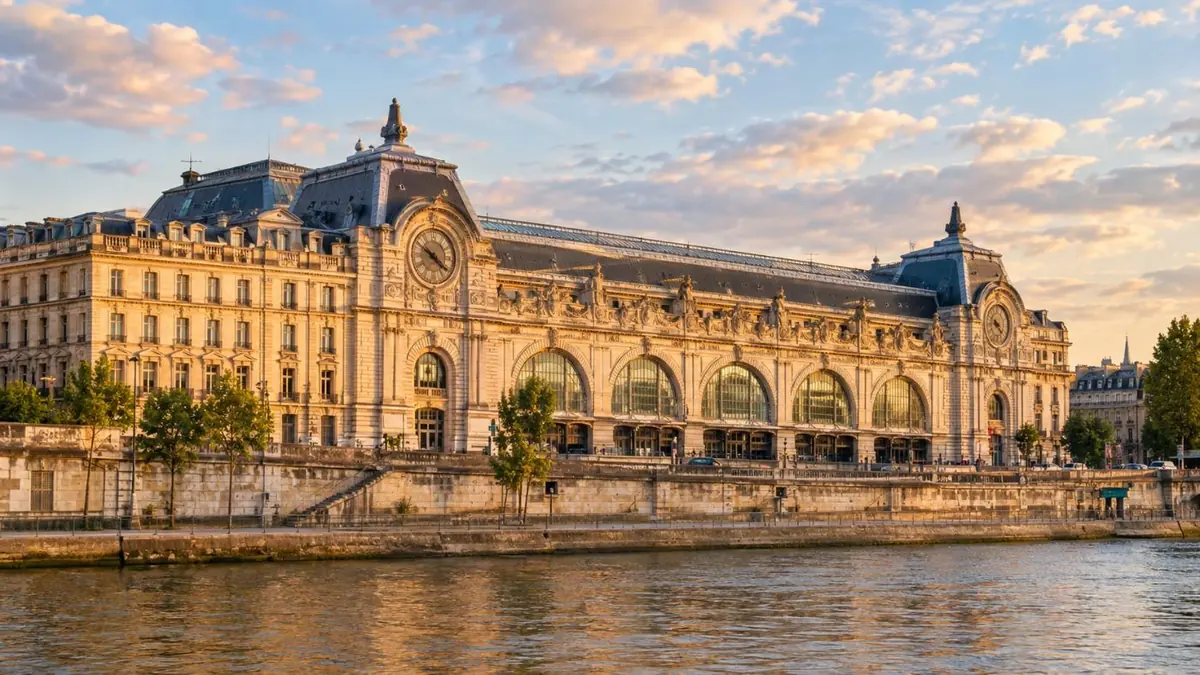
The Musée d’Orsay holds Moreau’s best-known works, Orpheus, Galatea, Jason, and there one moves from the Symbolists to the Impressionists in just a few rooms. The guided tours of Orsay cover this journey in two hours. Here are the group tour availabilities.
Frequently asked questions
Was Matisse really a student of Gustave Moreau?
Yes, at the École des Beaux-Arts in Paris, where Moreau was head of the studio from 1892 to 1898. Marquet, Manguin, Camoin, and Rouault were there as well. The master’s biography is on the page Who was Gustave Moreau?.
Why is it said that Fauvism was born in Moreau’s studio?
Because four of the Fauves from the 1905 Salon d’Automne—Matisse, Marquet, Manguin, and Camoin—met there and learned to seek their own colour rather than imitate the master.
Did Georges Rouault direct the museum?
Yes. A former student, he was its first curator, from its opening on 14 January 1903 until 1922. The full account is on the page history of the house-museum.
Can one see works by Matisse at the Musée Gustave Moreau?
No, the museum only preserves Moreau’s bequest. To see his students’ works, you must visit other museums, the Musée d’Orsay first and foremost. The guided tours of the Musée d’Orsay pass by Moreau’s works before moving on to the next generation.