History of the Musée Gustave Moreau
1852: a family home
In 1852, Gustave Moreau’s parents purchase the townhouse at 14 rue de La Rochefoucauld, in the new district already known as Nouvelle Athènes. Gustave is twenty-six years old. He sets up his studio there and never leaves. For forty years, it remains an ordinary bourgeois artist’s home, with the family’s apartment on the first floor and the studio above. The neighbourhood, which I discuss on the page Nouvelle Athènes, saw the likes of Sand, Chopin, Delacroix, and Géricault pass through.
1895: the painter builds his museum
In April 1895, Moreau asks architect Albert Lafon to transform the family home into a museum. He is sixty-nine years old, a professor at the École des Beaux-Arts, and knows his paintings have no place in the museums of his time. The 1896 renovations expand the building and add an extra floor. The result is two large superimposed studios on the second and third floors, connected by the wrought-iron spiral staircase Lafon designs for him. Moreau hangs his own paintings, designs the pivoting shutter cabinets for his drawings, and decides what will be seen. Today’s museum is, more or less, the one he staged.
1897: the will
On 10 September 1897, he drafts a will bequeathing the house and all its contents to the State, on one condition: to preserve “this character of a whole that always allows one to see the sum of the artist’s work and efforts.” This sentence explains the museum: the sketches, the unfinished works, the early copies are there because he wanted the process to be visible, not just the results.
1898–1903: death, Rupp, and the opening
Moreau dies on 18 April 1898. His universal legatee, Henri Rupp (1837–1918), a loyal friend, continues arranging the rooms according to his instructions. The State hesitates for a few years before accepting such an unusual bequest, then does so in 1902. The museum opens its doors on 14 January 1903. Its first curator is Georges Rouault, a former student, who remains in the post from 1903 to 1922. George Desvallières succeeds him from 1930. The list of students who passed through Moreau’s studio, and what became of them, is on the page Gustave Moreau’s students.
The museum was conceived by a living painter, not by a curator after his death. This is rare. When you climb the staircase, you follow a path he designed.
The 20th century: a museum that slowly opens up
For decades, only the studios were open to visitors. The first-floor apartment—dining room, bedroom, boudoir, hallway, and study-library—was not made accessible to the public until 1991. The ground-floor reception room was restored in 2003. Attendance remained modest: 24,379 visitors in 2001, 40,905 in 2012. These are provincial museum figures in the heart of Paris, and that is what gives it its charm.
2015: the renovation
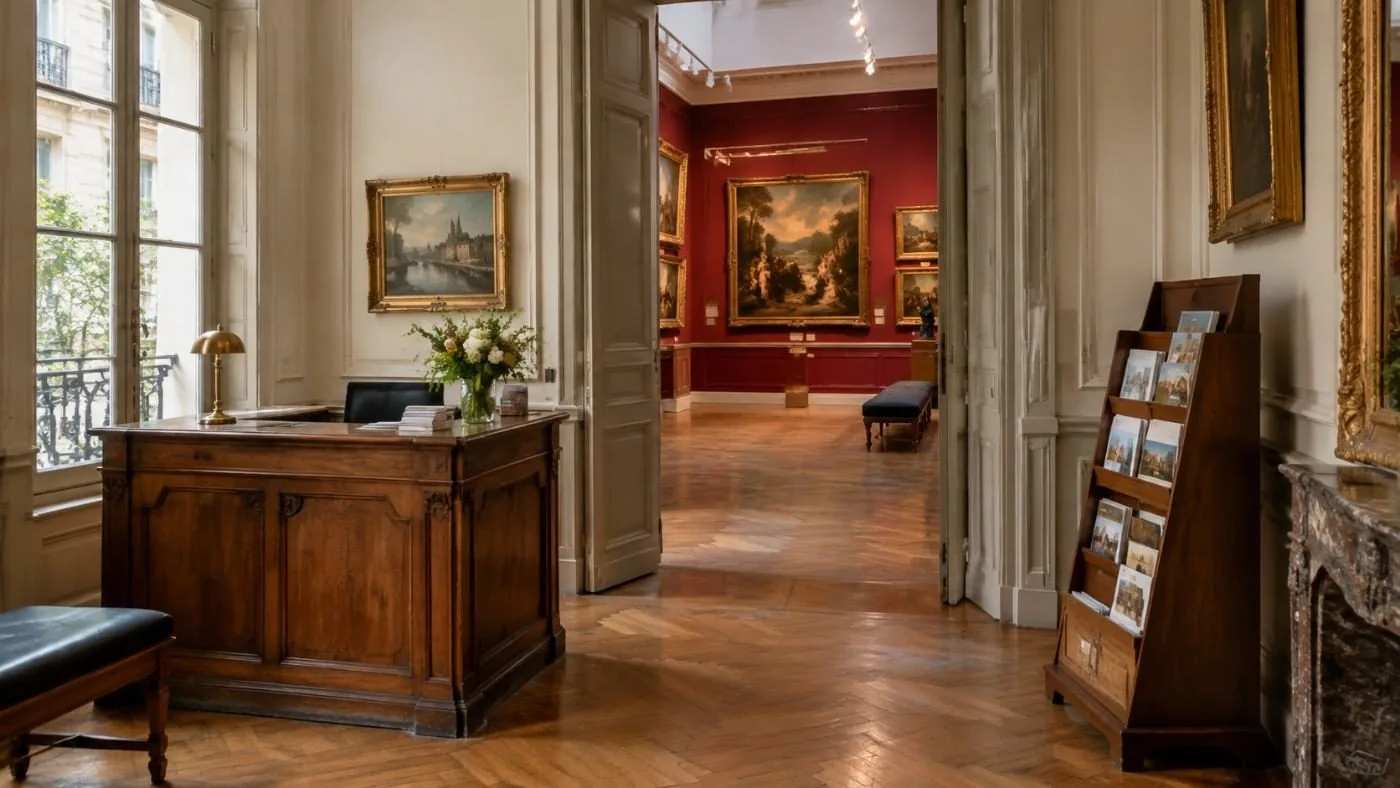
After a year of closure, the museum reopened in 2015. The ground floor was restored to its original state, storage spaces and a graphic arts cabinet were created to preserve the thousands of drawings. In the year of its reopening, attendance rose to 58,239 visitors, before dropping back to 39,238 in 2017. Around 40,000 per year is its steady pace, and there is still no queue at the door.
Since 2017: who owns the museum?
The State, since the bequest. The museum is a national museum under the supervision of the Ministry of Culture. Since 2017, it has formed, together with the Musée Jean-Jacques Henner—another artist’s house in the same district—a joint public administrative institution. Its director, since 2023, is Charles Villeneuve de Janti. The Association of Friends of the Musée Gustave Moreau, founded in 1990, supports it. The official website is musee-moreau.fr, where tickets can also be purchased; details on free admission and the combined reduced rate with five other museums are explained on the tickets page.
Visiting the house today
Open every day except Tuesday, from 10:00 to 18:00, as I detail on the opening hours page. The museum is included in the Paris Museum Pass, allowing you to add it effortlessly to a day at the Louvre or Musée d’Orsay.
Frequently asked questions
Who owns the Musée Gustave Moreau?
The French State, since accepting Moreau’s bequest in 1902. It is a national museum under the supervision of the Ministry of Culture, merged since 2017 with the Musée Jean-Jacques Henner into a joint public institution. We are an independent guide, not the museum, as explained on our about page.
When did the Musée Gustave Moreau open?
On 14 January 1903, five years after the painter’s death, with Georges Rouault as its first curator. The page Moreau’s pupils recounts the connection between the master and his former student.
Who built the spiral staircase?
During the 1895–1896 renovations, the architect Albert Lafon added a storey to the house and created the two superimposed studios. The floor-by-floor tour can be found on the page works to see.
Has the museum been renovated?
Yes. After a year of work, it reopened in 2015 with a ground floor restored to its original state, along with storage spaces and a graphic arts cabinet. The reception room had already been restored in 2003, and the apartment opened in 1991.